
Inflammatory bowel disease & the microbiome
Crohn’s Disease & Ulcerative Colitis
Inflammatory bowel disease (IBD) is complex, chronic, and deeply individual. This guide draws on the latest clinical evidence to help you understand what is happening in your gut — and what an integrative approach can offer alongside conventional care.
What is inflammatory bowel disease?
IBD is a chronic gastrointestinal condition characterised by persistent inflammation of the digestive tract. It affects millions of people worldwide and is most commonly divided into two main forms: Crohn’s Disease and Ulcerative Colitis (UC). Together, these conditions make up the vast majority of IBD cases.¹²
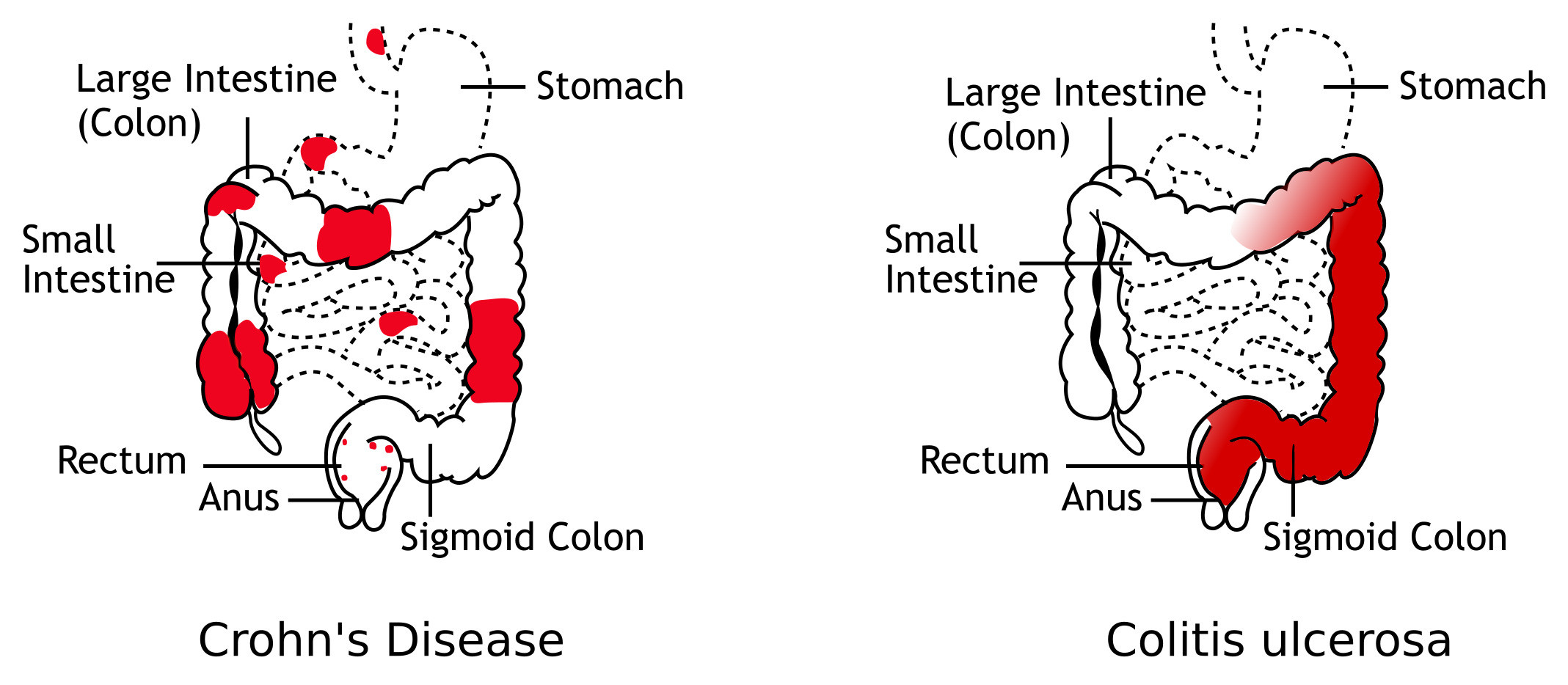
Own work, This file was derived from: Patterns of Crohn’s Disease.svg by Samir, vectorized by Fvasconcellos, CC BY-SA 3.0, via Wikimedia Commons
Crohn’s Disease
Crohn’s disease can affect any part of the gastrointestinal tract from the mouth to the anus, though it most commonly involves the last segment of the small intestine. Inflammation can affect the entire thickness of the bowel wall — and characteristically appears in “skip lesions” with patches of inflamed tissue separated by healthy segments.¹²
Ulcerative colitis
Ulcerative Colitis affects only the colon and rectum, with inflammation confined to the mucosa and submucosa- the innermost lining of the large intestine. Unlike Crohn’s, the ulceration in UC is continuous in nature and typically begins in the rectum, spreading proximally through the large bowel.¹²
Signs & symptoms of IBD
Both Crohn’s and UC share a similar set of intestinal symptoms, though severity and pattern vary considerably¹²:
- Abdominal pain and cramping
- Chronic diarrhoea
- Rectal bleeding
- Urgency to have a bowel movement
- Fatigue and low energy
- Unintentional weight loss
- Constipation (can alternate with diarrhoea)
- Nausea and reduced appetite
Extra-intestinal symptoms
IBD is a systemic condition, and inflammation can manifest beyond the gut:²⁴
- Musculoskeletal: Peripheral arthritis (type 1 & 2), axial spondyloarthritis, arthralgia
- Ocular: Uveitis, episcleritis
- Dermatological: Erythema nodosum, pyoderma gangrenosum
Complications of IBD
- Anaemia — iron deficiency, vitamin B12 deficiency, or anaemia of chronic disease
- Other nutrient deficiencies, especially folate (vitamin B9), vitamin D, zinc and magnesium
- Osteoporosis
- Intestinal strictures and fistulas
- Venous thromboembolism
- Increased long-term risk of colorectal cancer
How does IBD develop?
IBD arises from a complex interplay between genetic predisposition and environmental triggers. No single cause has been identified; the current evidence points to a multifactorial model:²⁵
- Genetics: A family history of IBD increases risk, though genes alone are insufficient
- Gut microbiome: Disruption to the balance of gut bacteria (dysbiosis) is both a contributor and consequence
- Environmental: Long-term medication use and environmental pollutants
- Stress: Chronic psychological stress is linked to flare onset and worsening disease activity
- Infections: Bacterial and viral infections can trigger or worsen flares
- Diet: Ultra-processed food consumption and low dietary diversity are associated with increased IBD risk²⁰²¹²³
A 2021 prospective cohort study published in the BMJ found that ultra-processed food intake was significantly associated with an increased risk of developing IBD, while a traditional whole-food dietary pattern was protective.²³
The role of the gut microbiome in IBD
The gut microbiome — the community of trillions of microorganisms living in the digestive tract — plays a central role in the development, perpetuation, and potential resolution of IBD.⁷⁹¹⁰
Microbiome patterns in Crohn’s Disease
These patterns can be seen on a stool microbiome test:
- Decreased microbial diversity overall
- Reduced butyrate-producing bacteria (particularly Faecalibacterium spp.)
- Reduced Akkermansia spp.
- Increased hexa-LPS-producing bacteria
- Increased oral species migrating to the gut
- Elevated Escherichia coli
Microbiome patterns in Ulcerative Colitis
These patterns can be seen on a stool microbiome test:
- Decreased microbial diversity
- Increased oral species in the gut
- Reduced Faecalibacterium spp.
- Elevated Escherichia coli and Proteobacteria signals
Pathogens and active flares
Infections are significantly more common during active IBD flares than during remission.⁶
- Clostridioides difficile has been identified in up to 26% of patients with active disease
- Non-C. difficile enteric infections are found in approximately 16–18% of symptomatic IBD tests
- UC cases show a higher prevalence of pathogenic E. coli strains, including EAEC and EPEC, compared to non-IBD controls
- Both Crohn’s and UC have higher rates of Campylobacter spp. compared to healthy individuals
Elevated E. coli enrichment (Proteobacteria dominance) has been associated with reduced responsiveness to anti-TNF medication in Crohn’s disease.³⁴ This highlights why understanding the microbiome may directly inform treatment decisions.
The microbiome in remission
Reaching clinical remission does not mean the microbiome has normalised. Even in remission, the gut microbiome in IBD patients remains impaired compared to healthy controls, with lower levels of beneficial SCFA-producing bacteria and higher inflammatory taxa.⁹¹⁰
- IBS-like symptoms can persist despite mucosal healing due to motility changes, visceral hypersensitivity, or SIBO⁹¹⁰¹³
- Baseline microbiome features can help predict future therapy intensification and relapse risk³⁴
- Higher Escherichia at the time of remission is associated with increased risk of relapse³⁵
Why microbiome testing can be helpful
Standard investigations for IBD — including blood tests, faecal calprotectin, and colonoscopy — are essential for diagnosis and monitoring. However, they do not provide insight into the specific microbial imbalances, immune function, and digestive markers that may be driving ongoing symptoms, contributing to flares, or preventing remission.
Comprehensive microbiome testing offers a deeper layer of clinical information that can meaningfully complement conventional care.
Microba’s Microbiome Explorer Comprehensive Test
Microba’s Microbiome Explorer Comprehensive is an advanced, clinically validated stool test providing a detailed analysis of the gut ecosystem. For individuals with IBD, it offers insight into areas that standard tests miss:
| What It Measures | Clinical Relevance for IBD |
|---|---|
| Gut Microbiome Composition | Identifies which bacterial species are present and their relative abundance, compared to a healthy cohort — including key species relevant to IBD such as Faecalibacterium, E. coli, and pathogenic strains like EPEC and EAEC. |
| Inflammation Markers (Calprotectin & Lactoferrin) | Calprotectin >200 µg/g is strongly suggestive of active IBD and supports escalation of care. Lactoferrin >7.2 µg/g confirms active neutrophil-mediated mucosal inflammation.¹⁴¹⁵ |
| Immune Function (Secretory IgA) | Secretory IgA is the gut’s first line of immune defence. Abnormal levels — low or high — can indicate immune dysregulation common in IBD. |
| Digestive Function (Pancreatic Elastase) | Provides insight into pancreatic enzyme output, helping identify why nutritional deficiencies may be persisting despite dietary changes. |
| Pathogen Screening | PCR-based detection of clinically relevant pathogens, including C. difficile, EPEC, EAEC, Campylobacter, and Dientamoeba fragilis, which may mimic or exacerbate IBD symptoms. |
| Microbial Functional Markers | Reports on hexa-LPS-producing microbes (systemic inflammation drivers), butyrate and propionate producers (mucosal healing support), hydrogen sulphide, trimethylamine, methane-producing archaea, and beta-glucuronidase activity. |
When to consider microbiome testing
- Baseline assessment — establishing the microbial landscape before beginning treatment
- During a suspected flare, to identify whether infection is contributing and to guide antimicrobial or probiotic strategies
- Monitoring therapy response — tracking microbial shifts after dietary, supplement, or medication changes
- In apparent remission — to identify residual microbial imbalances that may predict relapse or explain ongoing IBS-like symptoms
- Annual monitoring — to track long-term microbial stability and guide preventative interventions
Repeat testing over time allows practitioners to track changes in key markers like faecal calprotectin, E. coli abundance, and butyrate-producing species — providing early warning of microbial regression before symptoms worsen. This proactive approach may help prevent escalation to more aggressive treatments.¹³
Diet & Lifestyle in IBD
No single diet has been found to consistently decrease flare rates in all adults with IBD. Dietary approaches should always be personalised to the individual’s disease state, tolerances, and nutritional status.
The Mediterranean Diet
A recent consensus from the American Gastroenterological Association highlights the Mediterranean diet as beneficial in IBD management:²³²⁴
- A wide variety of fresh fruits and vegetables
- Monounsaturated fats (olive oil, avocado)
- Complex carbohydrates and legumes
- Lean proteins, particularly small oily fish rich in omega-3
- Low intake of ultra-processed foods, added sugar, emulsifiers, and salt
Crohn’s Disease Exclusion Diet (CDED)
The Crohn’s Disease Exclusion Diet is a structured, evidence-based three-phase protocol designed to reduce gut inflammation in Crohn’s disease. When combined with Partial Enteral Nutrition (PEN), it has been shown to induce remission and promote favourable microbial changes:²⁴²⁶
- Increased Faecalibacterium prausnitzii
- Increased Bifidobacterium spp.
- Reduced E. coli and Fusobacterium
CDED + PEN has been shown to have better patient compliance than Exclusive Enteral Nutrition (EEN) due to the inclusion of whole foods, with comparable remission rates.
Integrative support alongside medical care
Integrative care for IBD works alongside — not instead of — conventional medicine. Gastroenterology remains essential for diagnosis, monitoring, and medical management. The goal of integrative support is to reduce the inflammatory burden, support the microbiome, restore nutritional status, and address the environmental and lifestyle factors that contribute to disease activity.
Evidence-Based Nutraceuticals
Here’s a selection of supplements that could be helpful in IBD. This is not an exhaustive list, and it doens’t mean all of these should be taken. It’s important to work with a trained practitioner who can advise which supplements are right for you and at what doses – this is crucial as low levels often don’t have the therapeutic effect.
| SUPPLEMENT | PURPOSE & EVIDENCE |
| Curcumin (C3 complex) | An RCT found curcumin combined with mesalamine induced remission in mild-to-moderate UC. Anti-inflammatory and antioxidant support.²⁷ |
| Fish oil (EPA + DHA) | Omega-3 fatty acids support inflammatory resolution and have been shown to improve colonic differentiation markers and reduce inflammatory signalling in UC.²⁸²⁹ |
| Saccharomyces boulardii | Shown to reduce faecal calprotectin in active UC and to support microbial resilience.³¹ |
| L. gasseri KS-13 / B. bifidum G9-1 / B. longum MM2 | This three-strain combination has been shown to induce a less inflammatory cytokine profile and reduce E. coli overgrowth.³²³⁸ |
| Glutamine + PHGG + Zinc carnosine | Supports mucosal gut healing, barrier integrity, and epithelial repair. Glutamine is the primary fuel source for enterocytes. |
| GOS (Galacto-oligosaccharides) | A prebiotic fibre shown to modulate the faecal microbiome and immune function.³⁰ |
| Vitamin D | A 2024 systematic review found vitamin D supplementation effective in supporting the IBD disease course and immune functioning.³⁷ |
Ready to take action?
If you have persistent symptoms that don’t respond to the usual advice and treatment, please get in touch. The good news is that with the right testing, a personalised dietary and supplement plan, real improvement is possible.
Book a free 20-minute inquiry call today, and let’s have a chat.
Recent posts
References
- National Health Service (UK). Inflammatory bowel disease (IBD). NHS. Cited February 2026.
- Lamb CA, Kennedy NA, Raine T, et al. British Society of Gastroenterology consensus guidelines on the management of inflammatory bowel disease in adults. Gut. 2019;68(Suppl 3):s1–s106.
- Kucharzik T, Ellul P, Greuter T, et al. ECCO-ESGAR-ESP-IBUS Guideline on diagnostics and monitoring of patients with inflammatory bowel disease: Part 1. J Crohns Colitis. 2025;19(7):jjaf106.
- Kilic Y, Kamal S, Jaffar F, et al. Prevalence of extraintestinal manifestations in inflammatory bowel disease: a systematic review and meta-analysis. Inflamm Bowel Dis. 2024;30(2):230–239.
- de Souza HSP, Fiocchi C, Iliopoulos D. The IBD interactome: an integrated view of aetiology, pathogenesis and therapy. Nat Rev Gastroenterol Hepatol. 2017;14(12):739–749.
- Axelrad JE, Joelson A, Green PHR, et al. Enteric infections are common in patients with flares of inflammatory bowel disease. Am J Gastroenterol. 2018;113(10):1530–1539.
- Shin NR, Whon TW, Bae JW. Proteobacteria: microbial signature of dysbiosis in gut microbiota. Trends Biotechnol. 2015;33(9):496–503.
- Winter SE, Winter MG, Xavier MN, et al. Host-derived nitrate boosts growth of Escherichia coli in the inflamed gut. Science. 2013;339(6120):708–711.
- Halfvarson J, Brislawn CJ, Lamendella R, et al. Dynamics of the human gut microbiome in inflammatory bowel disease. Nat Microbiol. 2017;2:17004.
- Wills ES, Jonkers DMAE, Savelkoul PHM, et al. Fecal microbial composition of ulcerative colitis and Crohn’s disease patients in remission and subsequent exacerbation. PLoS One. 2014;9(3):e90981.
- Sanchis-Artero L, Martínez-Blanch JF, Manresa-Vera S, et al. Evaluation of changes in intestinal microbiota in Crohn’s disease patients after anti-TNF-α treatment. Sci Rep. 2021;11:10016.
- Ding NS, McDonald JAK, Perdones-Montero A, et al. Metabonomics and the gut microbiome associated with primary response to anti-TNF therapy in Crohn’s disease. J Crohns Colitis. 2020;14(8):1090–1102.
- Al Radi ZMA, Prins FM, Collij V, et al. Exploring the predictive value of gut microbiome signatures for therapy intensification in patients with IBD: a 10-year follow-up study. Inflamm Bowel Dis. 2024;30(10):1642–1653.
- York & Scarborough Teaching Hospitals NHS Foundation Trust. Faecal calprotectin care pathway. Cited February 2026.
- National Institute for Health and Care Excellence (NICE). Faecal calprotectin diagnostic tests for inflammatory diseases of the bowel (DG11). 2013.
- Walsham NE, Sherwood RA. Measurement of faecal calprotectin and lactoferrin in inflammatory bowel disease. Frontline Gastroenterol. 2011;2(1):13–18.
- Zhou XL, Liu W, Wu YJ, et al. Fecal lactoferrin in discriminating inflammatory bowel disease from irritable bowel syndrome. BMC Gastroenterol. 2014;14:121.
- Chavannes M, Dolinger MT, Cohen-Mekelburg S, Abraham B. AGA Clinical Practice Update on the role of intestinal ultrasound in IBD. Clin Gastroenterol Hepatol. 2024;22(9):1790–1795.
- Colombel JF, Shin A, Gibson PR. AGA Clinical Practice Update on functional gastrointestinal symptoms in patients with IBD. Clin Gastroenterol Hepatol. 2019;17(3):380–390.
- Gracie DJ, Guthrie EA, Hamlin PJ, Ford AC. Prevalence of IBS-type symptoms in IBD in remission. Lancet Gastroenterol Hepatol. 2020;5(12):1053–1062.
- Imai J, Kitamoto S, Sugihara K, et al. Oral–gut microbial overlap and oral taxa in the gut associated with IBD. JCI Insight. 2021;6:e148543.
- Salosensaari A, Laitinen V, Havulinna AS, et al. Faecal calprotectin and gut microbiome associations in a population cohort. Sci Rep. 2024;14:63893.
- Narula N, Wong ECL, Dehghan M, et al. Association of ultra-processed food intake with risk of IBD. BMJ. 2021;374:n1554.
- Levine A, Wine E, Assa A, et al. Crohn’s Disease Exclusion Diet plus partial enteral nutrition induces sustained remission in a randomized controlled trial. Gastroenterology. 2019;157(2):440–450.
- Cox SR, Lindsay JO, Fromentin S, et al. Effects of Low-FODMAP diet on symptoms, fecal microbiome, and markers of inflammation in patients with quiescent IBD. Gastroenterology. 2020;158(1):176–188.
- ESPEN Guideline on clinical nutrition in inflammatory bowel disease. Clin Nutr. 2023.
- Lang A, Salomon N, Wu JCY, et al. Curcumin in combination with mesalamine induces remission in patients with mild-to-moderate ulcerative colitis. Clin Gastroenterol Hepatol. 2015;13(8):1444–1449.
- Prossomariti A, Scaioli E, Piazzi G, et al. Short-term treatment with eicosapentaenoic acid improves inflammation and affects colonic differentiation markers and microbiota in patients with UC. Sci Rep. 2017;7:7458.
- Lyte JM, Gabler NK, Hollis JH. Postprandial serum endotoxin in healthy humans is modulated by dietary fat. Lipids Health Dis. 2016;15:186.
- Vulevic J, Drakoularakou A, Yaqoob P, et al. Modulation of the fecal microflora profile and immune function by a novel transgalactooligosaccharide mixture in healthy elderly volunteers. Am J Clin Nutr. 2008;88(5):1438–1446.
- Zhou W. Effect of Saccharomyces boulardii powder on fecal calprotectin and inflammatory factors in active ulcerative colitis. World Chinese J Digestol. 2017;25(22):2065–2070.
- Spaiser SJ, Culpepper T, Nieves C Jr, et al. Lactobacillus gasseri KS-13, Bifidobacterium bifidum G9-1, and Bifidobacterium longum MM-2 ingestion induces a less inflammatory cytokine profile in older adults. J Am Coll Nutr. 2015;34(6):459–469.
- Ojetti V, Petruzziello C, Migneco A, et al. Effect of Lactobacillus reuteri (DSM 17938) on methane production in patients with functional constipation. Eur Rev Med Pharmacol Sci. 2017;21:1702–1708.
- Microbiome signatures and biologic response/non-response in inflammatory bowel disease. J Crohns Colitis. 2020;14(8):1090–1102.
- Winter SE, Winter MG, Xavier MN, et al. Host-derived nitrate boosts growth of Escherichia coli in the inflamed gut. Science. 2013;339(6120):708–711.
- Raetz CRH, Whitfield C. Lipopolysaccharide endotoxins. Annu Rev Biochem. 2002;71:635–700.
- Valvano M, Magistroni M, Cesaro N, et al. Effectiveness of vitamin D supplementation on disease course in IBD: systematic review with meta-analysis. Inflamm Bowel Dis. 2024;30(2):281–291.
- Spaiser SJ, et al. Lactobacillus gasseri KS-13, Bifidobacterium bifidum G9-1, and Bifidobacterium longum MM-2 ingestion induces a less inflammatory cytokine profile in older adults: a randomized, double-blind, placebo-controlled, crossover study. J Am Coll Nutr. 2015;34(6):459–469.
- Rohani P, Ansari A, Shaygantabar M, et al. The effects of CDED alone versus CDED plus PEN on gut microbiome composition in pediatric Crohn’s disease patients. MicrobiologyOpen. 2025;14(5):e70099.


